
Self-employment can give parents more control over their schedules, but it can make family finances less predictable. One month may bring several large client payments, while the next is unusually quiet. Add childcare, groceries, medical expenses, taxes, and school costs, and traditional budgeting methods may fall short. A better approach is to build household finances around income fluctuations from the start.
Build the Household Budget From a Lower-Income Month
Using your average monthly income as a spending target can cause trouble because some months will inevitably fall below that figure. Review the past six to 12 months and identify what you typically earn during slower periods.
Build your essential household budget around that more conservative number. Start with housing, utilities, groceries, insurance, transportation, childcare, and minimum debt payments.
Higher-income months then create breathing room. Instead of immediately increasing discretionary spending, direct part of the extra money into savings or upcoming expenses.
Give Business and Household Money Separate Jobs
Keep business income and expenses separate from family spending. A dedicated business bank account makes it easier to see what the company actually earns after expenses.
Rather than transferring money to your personal account whenever a bill appears, consider paying yourself on a regular schedule. Even if the amount occasionally needs adjustment, this creates a clearer boundary between business revenue and household income.
Taxes also need their own space in the budget. Self-employed workers generally need to account for federal income and self-employment taxes themselves. Setting aside tax money as clients pay can prevent a future deadline from competing with family expenses.
Save for the Expected and Unexpected
An emergency fund can help cover a sudden medical bill, major car repair, or temporary loss of income. Self-employed families may also benefit from a separate income buffer for predictable slow periods.
Then consider expenses that are irregular but hardly surprising. Back-to-school shopping, annual insurance premiums, birthdays, holiday spending, professional licenses, and home maintenance can all be anticipated. Creating separate savings categories for these costs turns a $600 annual expense into a $50 monthly savings goal.
Protect the Family Income
Benefits that might come through a traditional employer become the family’s responsibility during self-employment. Health coverage is an obvious consideration, but parents should also think about what would happen if they became unable to earn an income.
Disability insurance may replace a portion of qualifying lost income. Life insurance can provide financial support for dependents after a parent’s death. Comparing life insurance quotes can be a useful starting point, but the amount of coverage matters just as much as the premium. Consider debts, childcare, housing costs, and the number of years children will remain financially dependent.
Keep Retirement on the Monthly Checklist
It is easy to postpone retirement savings when immediate family expenses feel more urgent. Self-employed workers, however, have several potential options, including traditional and Roth IRAs, SEP IRAs, and solo 401(k)s.
Contributions do not necessarily have to be identical every month. A parent with seasonal income might contribute more during stronger periods while preserving cash during slower ones.
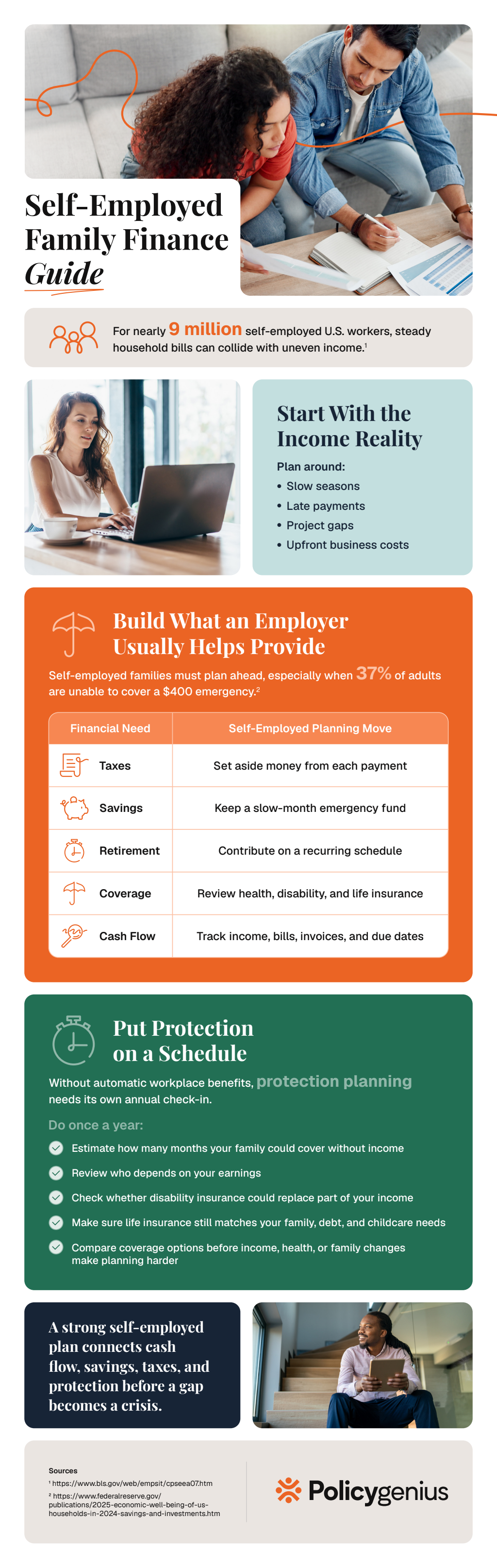
Self-employed family finances work best when variability is expected rather than treated as an exception. A conservative household budget, clear separation between business and personal money, dedicated savings, appropriate insurance, and consistent retirement planning can create stability even when monthly income changes. The paycheck may be unpredictable, but the system around it does not have to be. Look over the infographic below for more information.