
Nobody sets out to neglect their garden. It just sort of happens. You finish the living room, feel genuinely good about it, then step outside and the garden looks like it belongs to a completely different property.
Different era, different owner, different aesthetic sensibility entirely. And you stand there thinking, how did that happen?
It happens because most people apply completely different standards to outdoor spaces. Indoors, they’ll agonise over whether two shades of grey actually work together in afternoon light.
Outdoors, they’ll put down whatever paving slabs were on offer and leave a plastic table in the centre and consider it sorted. The result is a property that feels unresolved in a way that’s difficult to name but impossible to ignore.
Interior design principles don’t stop being useful at the back door. They just need to be reinterpreted slightly.
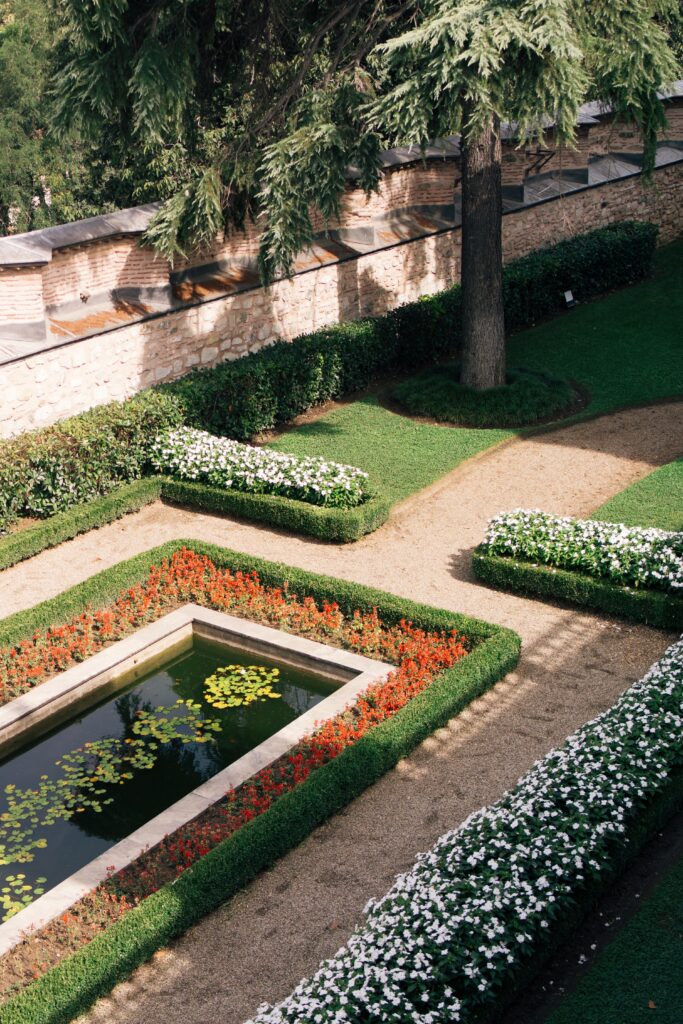
The Gap Between Inside and Outside
There’s a concept in interior design called visual continuity, which is the idea that a well-designed space feels like it belongs to itself. Nothing jars. Nothing fights anything else for attention.
Everything speaks the same loose visual language even when the individual elements are different.
Walk through a home where that principle has been applied consistently and you feel it before you understand it. Walk through one where it hasn’t and you feel that too, even if you can’t articulate why.
Most gardens fail this test badly. Not because the plants are wrong or the furniture is cheap, but because nobody carried the interior conversation outside. The home has a palette. The garden has a different one. The home has a material logic. The garden ignores it.
That disconnection reads as incoherence and it drags the whole property down aesthetically in ways that are genuinely fixable.
Colour and Texture: The Outdoor Version
Here’s something designers understand that most homeowners don’t think about: a limited palette is almost always more powerful than a varied one.
Three materials used with real intention will do more for an outdoor space than seven materials used without it. This is just as true outside as it is in any room.
Texture layering is another principle that translates perfectly and gets ignored almost universally in gardens. Smooth stone paving against rough timber. Soft planting against a hard rendered surface.
The contrast between materials is what creates richness. Without it, everything flattens into monotony, however nice each element might be individually.
Summer houses are actually one of the more interesting opportunities to apply this thinking. When a summer house is finished with materials that deliberately reference the main house, sharing a cladding tone or echoing a roofline proportion, it stops being a separate object in the garden and becomes part of a broader visual composition.
That’s not a small distinction. It changes how the entire property reads, from the house outward through the garden to the structure at the back.
Most people pick a summer house in total isolation from that conversation, which is why so many feel slightly marooned at the end of a garden, technically present but not quite belonging.
Furniture Placement Actually Matters
You wouldn’t push every piece of furniture against the walls in a living room and leave the centre of the room empty.
It creates that strange, exposed feeling, like a waiting room that’s slightly too formal. Same principle applies on a terrace, but people do it outside all the time without questioning it.
Groupings work outdoors for the same reasons they work indoors. They create enclosure. They signal that the space is meant for human occupation rather than passing through.
A seating arrangement that faces inward generates a different social dynamic than chairs that all face outward toward the garden.
These aren’t small details. They’re the difference between an outdoor space that people naturally gravitate toward and one they use only when there’s a specific reason.
Cohesion: The Detail That Changes Everything
The properties that feel genuinely well-designed share one consistent quality: materials carry across the boundary between inside and outside without abandoning the conversation.
Oak tones in interior joinery continue into timber outdoor furniture. A wall finish echoes in a garden structure finish. Nothing matches exactly, but everything relates.
A garden office is the clearest test of this. Placed without any reference to the home beside it, a garden office becomes a functional box that happens to sit in the garden.
Placed with attention to shared material logic and proportional thinking, it becomes an extension of the property. Functionally identical. Experientially completely different. The gap between those two outcomes costs nothing extra in budget.
It costs thinking time, which most people don’t spend because the garden office gets treated as a separate decision from the home’s design, rather than a continuation of it.
Why Build Quality Changes the Interior Feel
This is one that surprises people. The physical quality of an outdoor structure directly affects how a space feels to occupy, not just how it looks from the outside.
A 44mm log cabin has a wall mass that you register without consciously noticing it. The temperature holds more evenly. Sound from outside softens.
There’s a solidity that makes the space feel like a room rather than a temporary shelter, and that feeling changes how you use it and how long you stay.
Thinner construction doesn’t just perform worse in winter. It produces a different interior experience year-round.
It’s the outdoor equivalent of a room with poor acoustics or inadequate insulation: technically functional, but never quite comfortable enough to properly settle into.
Design Stops Nowhere
The most coherent properties are the ones where somebody decided, at some point, that the design conversation wasn’t going to stop at the back door. Not matching everything. That tips quickly into something heavy and self-conscious.
Just maintaining a visual thread between what’s inside and what’s outside, sharing materials loosely, carrying proportions through, letting the palette breathe across both spaces.
Start that conversation early, and the garden stops being the part of the property that doesn’t quite fit. It becomes the part that completes it.
