
A child stacking blocks, pretending to run a restaurant, or chasing a ball may simply look busy. Behind those activities, the brain is processing information, testing ideas, coordinating movement, and learning how to respond when something does not go as expected. Play gives young children repeated opportunities to practice developing skills in situations where they can experiment freely. That makes everyday play an important part of early brain development.
Play Builds Problem-Solving Skills
Open-ended activities require children to make decisions. Building a tower involves choosing pieces, balancing them, and figuring out why the structure falls. A puzzle asks a child to compare shapes and remember which approaches have already failed.
These experiences encourage flexible thinking because there is not always one obvious solution. Children can try an idea, see what happens, and change their approach.
Adults can support this process without immediately solving the problem. Asking a child what they think might work next gives them space to test their own reasoning.
Pretend Play Exercises Language and Memory
A cardboard box can become a bus, spaceship, kitchen counter, or doctor’s office. Pretend play requires children to hold ideas in mind while deciding what should happen next.
Language often develops naturally during these games. Children name objects, assign roles, explain imaginary situations, and respond to other players. Playing with siblings, parents, or friends adds another challenge because everyone has tocommunicate enough to keep the shared story moving.
These experiences can complement more structured learning found in toddler education programs, where songs, stories, guided activities, and peer interaction may give children additional opportunities to practice communication.
Physical Play Connects the Brain and Body
Running, climbing, throwing, dancing, and balancing require constant communication between the brain and muscles. A child trying to catch a ball has to track its movement, judge distance, position the body, and react quickly.
Fine motor play develops different abilities. Drawing, building with small blocks, working with modeling dough, and fitting pieces together require controlled hand and finger movements. These skills eventually support tasks such as writing, fastening clothing, and using utensils.
Children benefit from opportunities for both large and small movements rather than spending most playtime on one type of activity.
Games Help Practice Self-Control
Many childhood games involve waiting, remembering instructions, or changing behavior in response to a rule. Even a simple game of freeze dance asks children to move enthusiastically and then stop themselves at the correct moment.
These activities exercise executive functions, a group of mental skills involved in attention, working memory, and self-control. Those abilities become important as children begin following classroom routines and completing tasks with several steps.
Social games add another layer. Children may have to take turns, negotiate roles, cope with losing, or adjust when another child has a different idea.
Children Also Need Room to Direct the Play
Adult-led activities have value, but children benefit from choosing what to do sometimes. Self-directed play asks them to create goals rather than simply follow instructions.
That freedom does not require elaborate toys. Blocks, art supplies, balls, dress-up clothes, cardboard boxes, and outdoor spaces can support many different kinds of play. The child supplies much of the challenge through imagination and experimentation.
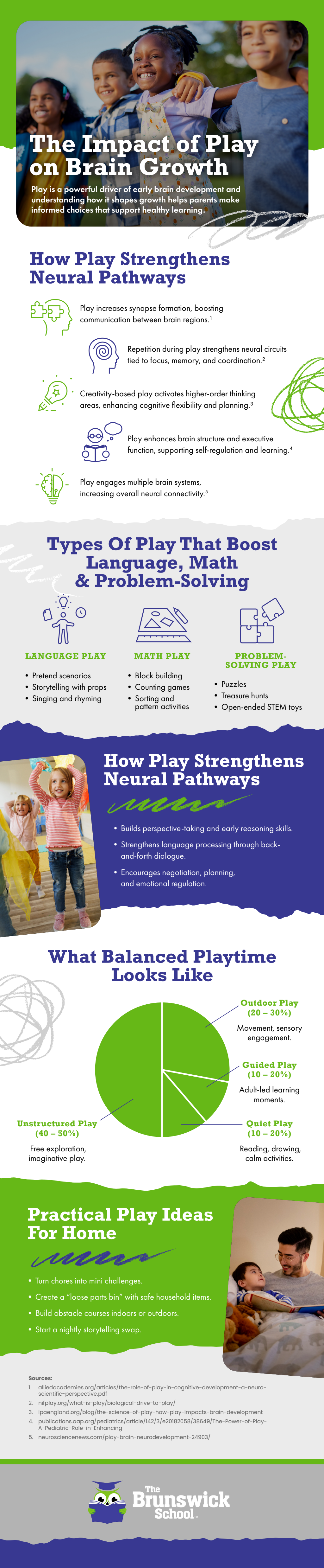
Play contributes to brain development because it brings thinking, movement, language, memory, and social interaction into everyday experiences. Providing safe opportunities for play gives children a chance to practice skills. Check out the infographic below for more information.